)
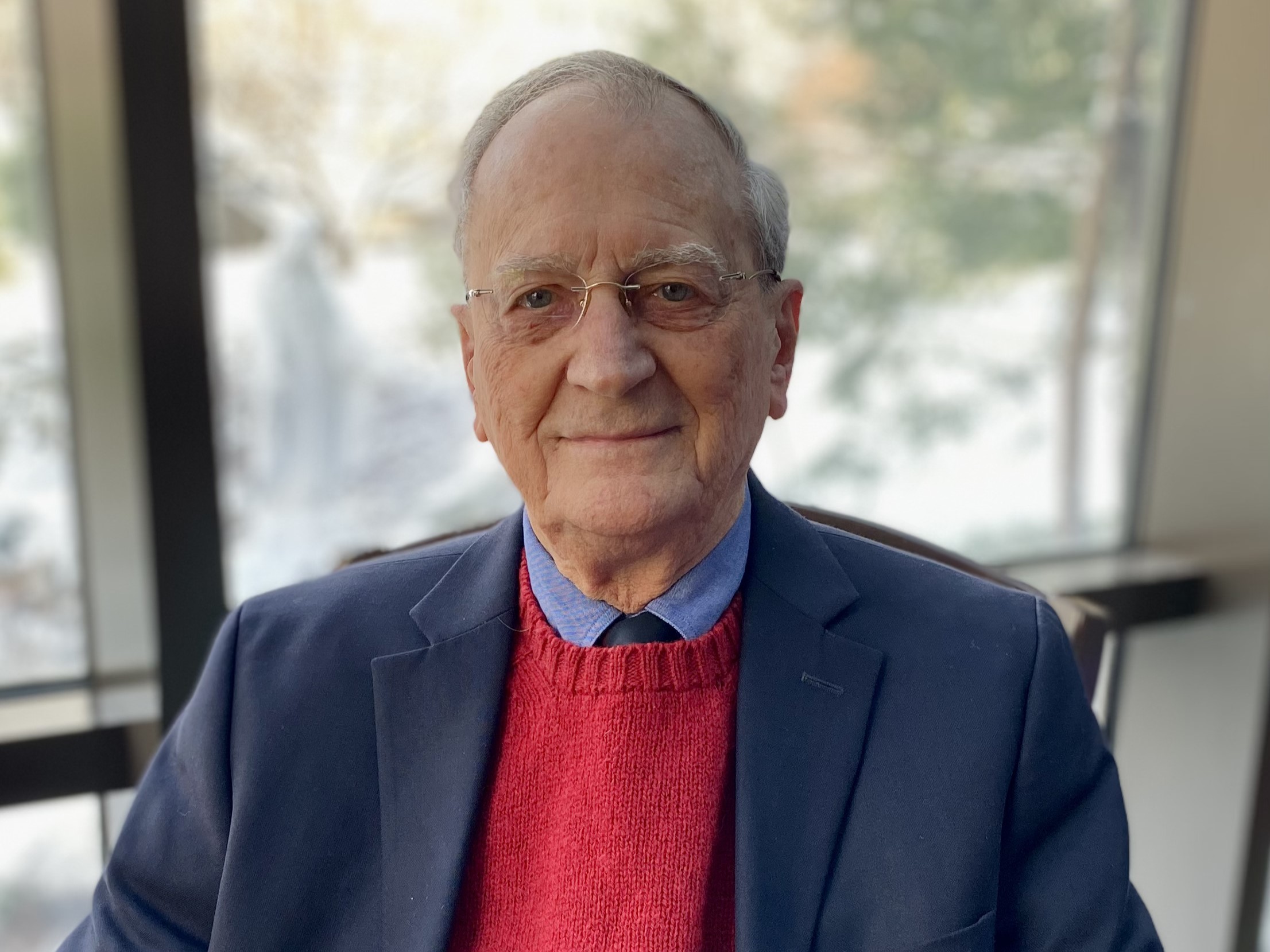
Introduction by Andreas Telser
For a growing number of Christians, mainly in the Western hemisphere, church-talk has become problematic for many reasons. However, for theology to shy away from or even avoid questions of the church only further limits the credibility of theology. Throughout his œuvre, Roger Haight has consistently tackled challenging issues for contemporary publics. His straightforward plea for new ways of thinking about the church gains special weight against the backdrop of his having also experienced the restrictive side of the church (policy).
In the last two years, American Jesuit Roger Haight (1936–2025) had several online encounters with the Research Center “Religion and Transformation in Contemporary Society,” for which we are very thankful!
The following lengthy text, published in three parts, was Haight’s last published work before his death in June 2025. We are grateful to America Magazine for the chance to republish it here.
On New Ways of Thinking about the Church by Roger Haight SJ (Part II)
Strategy for reimagining the church
Most Christians have a general idea of how the church developed. The New Testament provides the main entrée into that process, but it does not paint an exact picture of how the church took form in response to the preaching of Jesus and his execution. Critical reconstruction of the apparitions to disciples and the history provided by the Acts of the Apostles yields only fuzzy historical data about the period between Jesus’ death and the earliest letters of Paul. A distinctive theological perspective on that period will not yield new historical details, but it will help us to reimagine the dynamics of how the church developed.
I begin with a seemingly obvious distinction within the New Testament’s presentation of Christian faith. The first three Gospels present the ministry of Jesus in narrative form; the rest of the New Testament follows a developing Christian movement (Acts) and offers theological commentary on the person of Jesus. John’s Gospel straddles this distinction because it reflects a more developed, Christocentric view of the world. The distinction lies between a Jewish Jesus preaching the rule of God found in the earlier Gospels and the rest of the New Testament focused on the person of Jesus; the development moves from Jesus’ representation of God to an interpretation of Jesus.
Anyone familiar with this transition would know that this oversimplifies the New Testament texts, because all the Gospels express precisely Christian faith in Jesus. But one has to recognize that Jesus was a Jew, not a Christian. Many exegetes agree that the Jesus behind and within the first three Gospels did not preach himself as Messiah but promoted the rule of God. After that, the Christian apologetic concentrated less on Jesus’ message (while obviously not ignoring it) and more on his person in order to establish and explain his messiahship.
The Catholic Eucharistic ritual follows this basic structure. The Liturgy of the Word tells the Gospel stories of Jesus’ ministry against their traditional background as found in the Old Testament. This follows a logic of prophecy and fulfillment in the Christian imagination; more deeply, it preserves the historical continuity of Jesus’ formation in his tradition.
The Eucharistic prayer that follows the Liturgy of the Word resembles the second dimension of the New Testament. Theological ideas dominate the language and communicate a framework shaped by the recognition of sin and represent Jesus Christ as a sacrifice that won God’s forgiveness. According to St. Anselm, who had an outsized influence in solidifying this doctrine in Western theology, this atonement was a transaction between a Chalcedonian Christ (a single person with two natures, divine and human) and God the creator. A history of theological speculation distinguishes between the Liturgy of the sacrament and the Liturgy of the Word.
The significance of this reflection lies in its implication for a comprehensive vision of the church. Importantly, the distinction between Jesus and later interpretation of him does not in any way impugn that interpretation. But we are looking for a formula that welds together a holistic vision of the church as beginning with a group of disciples who continued to assemble for meals in remembrance of the prophet, teacher and healer. This began with meals with Jesus during his ministry and has continued to this day. The allegory of the disciples on their way to Emmaus conveys it. They talked about Jesus, reflected on their Scriptures and recognized his presence in the breaking of the bread. This image of the church refers to a massive “model” of the institution and to each assembly gathered today for the ritual. People who are leaving the church are not simply abandoning a worldwide institution, but their parochial assemblies.
Using the distinction between Jesus and interpretation of him as background, we can imagine the following plan for reimagining the church. First of all, it works within a framework of a theology of revelation with a distinctive structure: the transcendent object that is revealed (God), the historical medium through which revelation draws its content (Jesus) and the reception of the revelation that actively interprets it (his followers). In short, Christian revelation opens up a consciousness of God, through Jesus of Nazareth, to the disciples affected by it. The conception fixes attention on the mediation of Jesus of Nazareth, whose ministry can be discerned principally but not exclusively through the texts of the earlier Gospels.
Abraham Heschel
Following Jesus’ ministry, the church came to be through the disciples who had encountered him. The teaching and ministry of Jesus were the key elements for determining what the church, as a community of disciples, would look like. He is the mediating source of Christian faith. A way of catching the accent of Jesus’ ministry would situate it within the context of the Jewish theology that shaped his thinking and acting. I look to Abraham Joshua Heschel for a representation of Jewish anthropology and theology drawn from the Bible but expressed to a post-Holocaust modern world. This stage of reimagining the church turns to Jesus’ teaching by reading it in the light of a present-day representation of the biblical faith from an American Jewish religious thinker.
Reimagining the church today will vary with the interpreters themselves. The formulation of the task releases almost as many readings of the data as there are situations, needs and the proclivities of the interpreters themselves.
Before moving to a fuller description of Jesus’ appeal for religious participation as a guideline for actualizing the church, it is important to offer a brief introduction to Heschel and the main categories from his theology that correspond to Jesus’ teaching and can be used as guidelines for reimagining the church today.
Abraham Joshua Heschel was born a Hasidic Jew in Warsaw in 1907. He never lost his vivid experience of God and his ability to communicate it. He finished his higher education in Germany after working extensively on the Jewish prophets. He escaped the Nazi occupation of Poland by emigrating to the United States, where he found a teaching position at Hebrew Union College in Cincinnati in 1940. He joined the faculty of Jewish Theological Seminary in New York in 1946. During the course of his career at J.T.S., he published widely and aligned himself with the civil rights movement led by Martin Luther King Jr. His anthropology and theology rely heavily on biblical teaching, with an emphasis on the prophets.
I would argue that Heschel’s digest of the Jewish Bible’s teaching correlates neatly with Jesus’ teaching and can be carried forward into norms that apply to the church today. These include the personhood of God. The creating power that sustains the universe is personal, and God’s reliance on human freedom in our world is the same. This means that God does not control human history, but in various ways leaves history in our hands. Shifting to anthropology, one can easily note that Heschel’s interpretation of the role of gratitude and responsibility are similar to the foundational characteristics of Jesus’ Jewish spirituality. These themes come together in the formation of a community whose public face generates hope and an active life in society.
One can reimagine the church using basic principles of Jesus’ revelation of God and interpreting them against their Jewish background. The approach highlights a number of themes that should characterize the substance and face of the church. It responds to the criticism that doctrine has been abstracted from the teachings and ministry of Jesus. It promotes an image of church that applies to the largest institutional structures of the church and reaches the basic ecclesial unit, including the structure of its worship service. It respects the correlation between the lex orandi and the lex credendi, the relationship between the rule of prayer and the rule of belief. Congregational worship is the primary place where the church’s institutional form encounters its member participants.
Continue reading part III (to be published soon)!
This excerpt is reprinted with permission from America magazine, published by America Press, Inc. © 2025. All rights reserved. To read the full article, please click here or visit www.americamagazine.org. For subscription information, call 1-800-267-6939 or visit www.americamagazine.org/subscribe.
Please note, the collected volume Breaking Boundaries in Theology. In conversation with Roger Haight SJ which critically discusses some of Haight’s central theological issues is now available in open access at Brill: https://brill.com/edcollbook-oa/title/72372.
RaT-Blog Nr. 20/2025
Photocredits: Portrait provided by the author